
Absorbing Place on a Writing Retreat
28.1.26
By Shelley Dark for Imagine Greece Retreats
Writing retreats: why I go
Writing is a solo sport. But getting better at it almost always requires other humans.
Enter the writing retreat. Someone else designs the schedule, handles the logistics, and all I have to do is show up somewhere unreasonably beautiful and write.
Think sun-dappled verandah, a tutor who knows what they’re doing, and a small group of fellow writers, all gently—or not so gently—interrogating each other’s work. I’m talking about a retreat that doesn’t just enable brilliance. It corrals it.
The structured mornings
Mornings are structured, thank goodness. We arrive as freshly caffeinated strangers: hair still wet, one radiating expensive aftershave, the introvert in the black polo neck, someone oozing so much confidence he’s sedated by it. Chairs scrape. Laptops slide into place. Someone is late, bursting in with a flurry of apologies.
We introduce ourselves. Then the tutor starts, and bam—ideas ricochet, notes fly, people interrupt or sit mouth-open ready to pounce, and suddenly we’re debating parts of speech: whether adjectives are literary glitter—delightful in moderation—and adverbs the very devil, or just misunderstood. I nod wisely while silently repeating, “verbs are the weightlifters—make them lift.” And occasionally, “put the word thrust down, and no one gets hurt.”
I absorb a ridiculous amount of writing craft—pacing, voice, tension, the dark art of killing your darlings. But half the joy is watching the group: seeing who leans in like they’ve cracked the bestseller code at last; who goes quiet before saying the thing no one else was game to say; who reads so softly you have to lip-read; and who delivers every line as if auditioning for the film. Someone always cries, which makes me cry too.
It’s deeply satisfying. It’s funny. It’s occasionally mortifying—in the best way. And every time, it reminds me why I hauled myself out of my comfortable office and onto a plane. Writing may be solo, but getting better at it is infinitely richer together.
Meals at night
Evenings are the part I love most. No decisions. No “where shall we eat?” Just a long candlelit table where plates appear like magic. Bread gets passed. Glasses get topped up before you’ve noticed yours is low. It’s dangerously easy to eat too much, drink too much, and say a little too much. Forks pause mid-air. A sudden silence, then laughter, then someone murmurs, “Yes, but have you tried saying that to an agent?”
The wine-warmed camaraderie knits us together fast. I still have friendships that began over retreat dinners—because nothing bonds writers quite like good food, too much wine, and the shared knowledge that tomorrow we’ll all start the world’s best masterpiece. Or not.
In-between hours: absorbing place, alone
Then there are the in-between hours—the unscheduled stretches. They are easily filled with group chatter or outings, but I choose to use them for wandering alone.
I absorb place constantly, yet it happens best—deepest, sharpest—when I’m on my own.
Not because I dislike company, but because something shifts when no one is asking how long I’ll be taking notes, photographing, or wondering if I thought the big guy’s ending landed. I did. I talk to strangers more. I notice things I’d otherwise walk past.
I’m a retreat groupie. Paris, Florence, Hydra, Tasmania—very different places, same process. Solo wandering nudges the mind into a different gear.
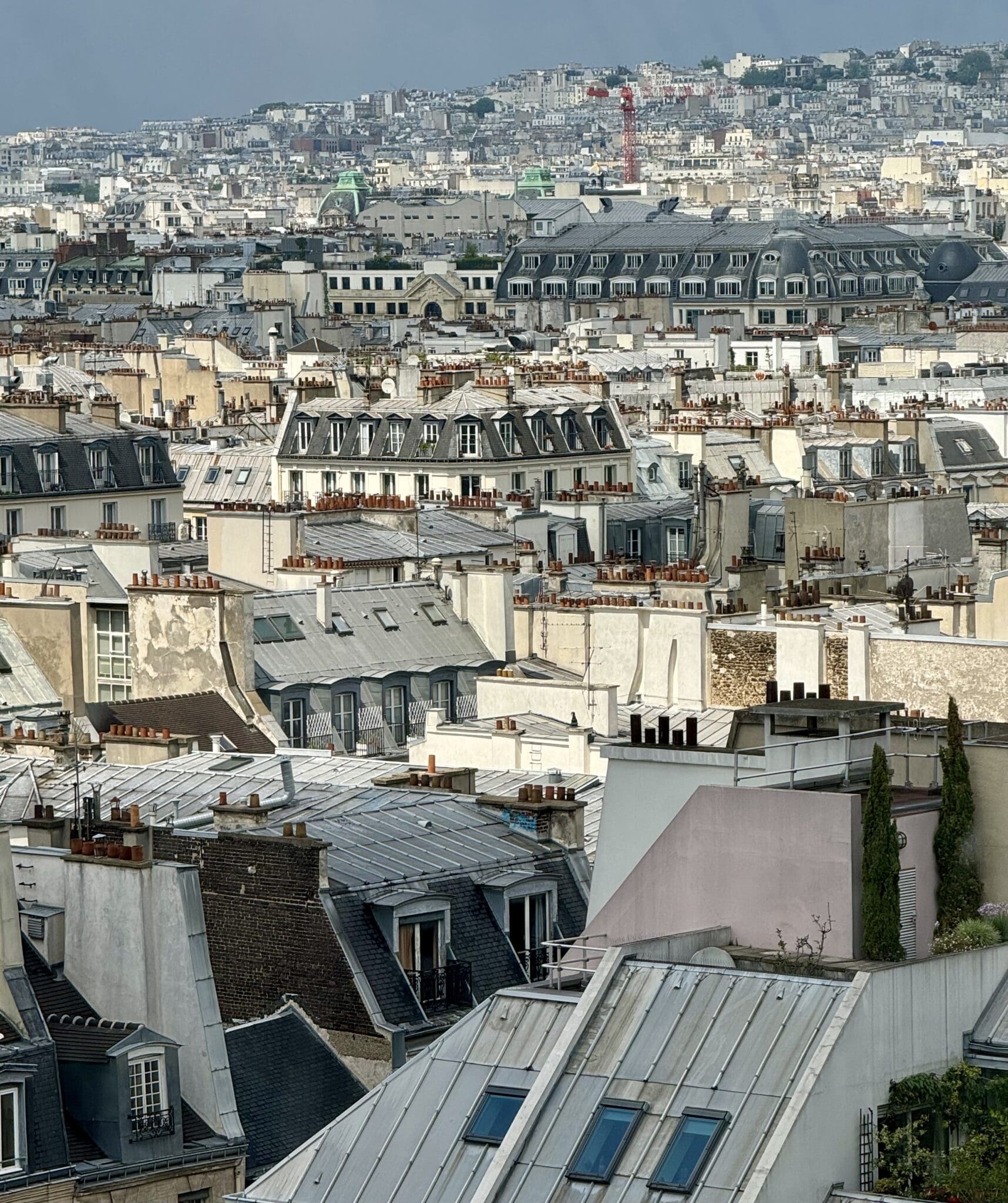
Paris? Where else to absorb a place than at Georges, the glass and air restaurant perched on top of the Pompidou. The discreet clink of cutlery, a battalion of long-stemmed red roses, one on each table, lined up with military discipline. A French waiter calls me Madame,and instantly, I’m more French than Dior. Je m’abandonne and order the lobster salad and a glass of chilled champagne.
The rooftops of Paris are laid out at eye level exactly as they should be. Grey light outlines grey on grey on grey—ridged zinc, steep slate, pale stone. I take in the hauteur slowly—not the height of the buildings, but their Parisian attitude. Mansard windows, dormers, attic hatches, mirror skylights, parapet walls, chimney pots: order within disorder, each precisely where it belongs. I notice how pleased I am with myself, register it, and carry on.
But add a few fellow writers—talking shop, comparing notes, ordering another bottle—and this private Paris would withdraw.
In Florence, I climb the slippery gravel of a vertical zigzag toward the Boboli Gardens. Lawn terraces carved into the hillside. Steps chained off because they’re dangerous—more to protect the terraces than the visitor. Statues and urns that have seen entire families rise and disappear. Admiration gives way to calculation. Who could have seen whom, from where? Who would never be missed?
With company, I’d value the view. By myself, I’m a Medici planning a murder.
Tasmania lowers the volume: dawn sky wide and pale, boardwalk over a tidal swamp, birds glide in to skid to a soft splash landing, grey-green reeds, a platypus ducking and diving in a dam—unlikely to show if I were mid-conversation. I leave quieter than I arrived. In the van taking me back to Hobart, I offer half my sausage roll to the woman beside me. She accepts. We lick tomato sauce off our fingers.
Hydra has its own speed. Halyards slap masts. Donkey hooves strike stone. Salt wind. Baking bread. Coffee. Cats stretched across every threshold. By noon, flattering morning light has shifted to forensic. Overexposed. Grilled fish with violently green olive oil, bread torn, not sliced, cold wine from a dinted anodised beaker. Hydra doesn’t care what I’m working on. It would feel the same whether I’m writing a masterpiece or doing nothing of value at all. I eat slowly. I notice I’ve stopped hurrying.
That, it turns out, is the lesson.
I can’t wait to add an Imagine Greece Retreat to my list, too.
These internal responses are placed. They matter more than monuments, which sit there being impressive regardless of how you feel.
I don’t always wander well. On the Frecciarossa from Florence to Milan, after the retreat—when I was meant to get off at Bologna—I was busy absorbing what seemed to be male-only business class. The compartment was a space-age capsule of black leather and brushed metal, with a tray table snapping down from the seat in front and a neat little hook for my (thankfully) smart Italian jacket. Everything designed to suggest forward motion.
Settled, I began studying my companions. An older man in a flannel shirt with architectural plans on his table looked as though he ran half the construction industry. Tight suits that cost a fortune. Polished shoes. Authority worn with sprezzatura. I was reading the room with great concentration.
Only belatedly did it occur to me that I’d been on the train a touch too long. I leaned over and asked the man in flannel. He smiled—kindly, amused—and confirmed it.
We were underground. Black windows. No scenery, no warning. We were pulling out of Bologna.
I stood up just as the doors shhhhhh-closed.
No regrets
This is the downside of going it alone: when I’m properly inside a place, the practical world occasionally drops out of view.
I’d do it again. Not the missing-the-stop part—I had a plane to catch, and I’m not a complete idiot—but the absorption that caused it. That only happens when no one is reminding you of the timetable.
I’m not arguing for solitude over company. They do different work. Group time feeds ideas. Solitary time feeds perception. I need both.
—

Shelley Dark is a bestselling and award-winning Australian author of historical fiction and narrative nonfiction. After a lifetime raising cattle on Queensland’s Granite Belt, she reinvented herself as a writer, relocating with her husband to the Sunshine Coast and embarking on a research journey that took her to archives in Greece, Malta, Britain, Ireland and Australia.
Her light-hearted travel memoir Hydra in Winter traces her solo winter journey to the Greek island of Hydra in search of her husband’s ancestor, Ghikas Voulgaris—Australia’s first Greek convict, sentenced to death for piracy. The book was named a Notable Book of 2025 by one of Australia’s most respected literary critics, Samuel Bernard, in The Weekend Australian, and awarded a Gold Medal in the Global Book Awards, 2025.

Her latest novel, Son of Hydra, is a sweeping historical fiction inspired by Ghikas’ life, spanning the Greek War of Independence to early colonial New South Wales. Shelley’s work explores exile, identity, belonging, and reinvention, and is known for its rigorous research, emotional restraint, and vivid sense of place. It has won wide critical acclaim and a Silver Medal in the Global Book Awards, 2025.
She is a member of two writers’ groups: the ALLWRiTE Club, and Noosa’s Writers on the Coast.
When she’s not writing, she is usually researching or travelling. And she’s always hot on the trail of the perfect cream bun.