
Master the Art of Greek Folk Dance: A 2026 Guide to Tradition, Kefi and Dance Retreats
What is Greek dancing?
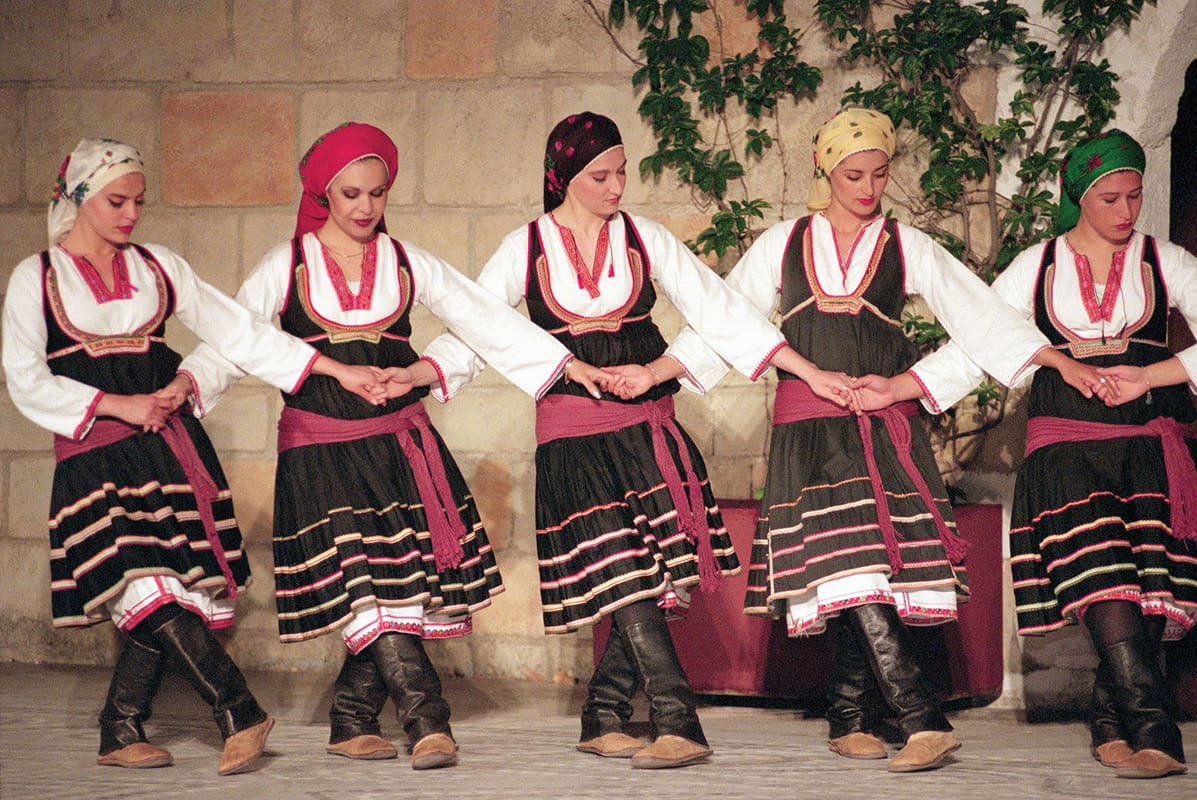
Have you ever wondered what traditional Greek folk dance is and how you could learn it? Greek dance (choros; Greek: χορός, Romanized: chorós) is one of the few living traditions that have survived for centuries. While most traditions fade over the years, Greek circle dances are one of the few that remain just as popular. Each region formed its own choreography and style, which reflects on its culture and way of living. For example, island dances usually have a smooth flow to them, while Pontic dances, closer to the Black Sea, are sharp. There are over 10,000 traditional dances that come from all regions of Greece, some more popular than others, which are performed in large circles or groups of people in traditional festivals by people of all ages. Clearly, nobody knows all of them. The most popular ones are Sirtaki, Hasapiko, Zeibekiko, Kalamatianos, Tsamikos, Ikariotikos, Pentozali, and Maleviziotis.
Putting that aside, what does Greek folk dance entail? Dancers usually hold hands or link arms and move together in a circle or open line, usually led by a leader who improvises in certain parts of the song while the rest follow fixed steps. Each dance has a regional style—such as the slow syrtos or the faster, accented kalamatianos—and their simple steps allow anyone to be able to keep up with the basic ones. Live music replaces loud speakers even today, and in local gatherings (especially in the islands), everyone is quick to jump in. The emphasis is on synchronization, continuity, and shared movement, reflecting its role in social gatherings rather than a stunning, unique performance.
What was its role in Ancient Greece?
In Ancient Greece, dance was a form of ritual, as well as a pastime activity for enjoyment. It was often included in ceremony rituals and religious activity, as well as hunting communities. Back then, dance-training was a foundation subject in school which is evident by the pictures of boys and girls dancing with the supervision of a tutor in ancient vases. Additionally, Ancient Greek dancing was also seen as a bridge between the living and the dead, often taking part in funerals and gatherings of age, as well as being used as an offering to gods, which is still visible in many religions.
It was often presented as an offering to Dionysus and Apollo. Dionysus, being the god of wine, festivity, and theatre, as the symposia, Greek gatherings, were usually accompanied by glasses of wine and other beverages, and Apollo, being the god of prophecy, art, and music. The origins of the dance date all the way back to the 2nd millennium BCE. Many consider the home of authentic Greek folk dance to be Crete, the birthplace of the Minoan empire and a top destination for Cretan dance retreats today.
Why does Greek dancing play such an important role?
For starters, dance has a direct emotional effect by releasing tension and heightening your mood, and “fixing your Kefi”, which is the Greek word for a joyous, festive spirit with a deep passion for life. It engages the body and nervous system simultaneously through somatic movement, allowing emotions to be expressed physically rather than verbally. As a result, dance often produces feelings of clarity, belonging, and emotional release. Apart from its physical effects, dancing with other people creates a stronger feeling of community and connection through shared movement and rhythm.
Greek folk dancing’s easy steps and linked arms allows people to bond, especially in villages and small towns where everyone already knows each other, and can even be seen as an intimate activity to dance in duets.
Where can I learn Greek dances?
The first way is the most obvious: find a tutorial or a personal tutor to learn Greek dancing. If you have access to a local Panigiri (village festival), you can also personally ask someone dancing to show you the steps. It might sound nerve-wracking, but most local residents would be honored to show you the steps of one of their most important traditions, especially if you are a foreigner. The element of hospitality and unity is very evident in authentic Greek culture, and they value anyone who wants to take part. But why go through all that trouble when you can simply join us in one of our retreats and learn the art with other like-minded foreigners by a Greek folk dance instructor?
Certain retreats include a Greek folk dance learning session, often followed by going to a festival or local tavern to dance together after your meal. Through our retreats, you can experience Greece first-hand as well as learn how to write, or even just relax after a stressful time period and read your favorite book by the beach with a beverage of your choice.
Join our Greek movement and wellness retreats in 2026, where we bridge the gap between ancient ritual and modern relaxation. From learning the Ikariotikos on the beach to experiencing an authentic Panigiri, our retreats are designed for those seeking community, culture, and a true Mediterranean reset.